
Upland City Directory Holdings
The documented historical shelf is wider than a directory title list. Upland Public Library describes a non-circulating local-history collection, and the research record identifies newspapers, photographs, yearbooks, oral histories, census material, maps, and county indexes that can be read beside a city directory. The coverage table separates known collection boundaries from the local directory volumes whose publisher and year details still require an onsite inventory.
| Collection | Coverage | Where Held | Access |
|---|---|---|---|
| Upland local-history records | Late 1800s-present, item-dependent | Upland Public Library | Non-circulating; contact and schedule a visit |
| Local city and business directories | Exact volumes not published online | Upland Public Library | Staff and call-number verification onsite |
| Upland News and North Ontario News | Founded 1901; digitized twentieth-century issues | California Revealed and Upland Library | Online keyword and browse search; check OCR variants |
| School yearbooks | Years not itemized officially | Upland Public Library | Ask by school and year |
| Photographs and oral histories | Late nineteenth and twentieth-century material, item-dependent | UPL, OAC, Calisphere, and California Revealed | Search people, streets, businesses, and events |
| Federal census | 1790-1950 released; local use especially 1900-1950 | NARA, Ancestry, and FamilySearch | 72-year rule; pair with local sources |
| 1907 Ontario Sanborn set | 17 sheets; Upland named as a secondary place | Library of Congress | Free digitized map images and public-domain access |
| Recorder name index | 1925-present online | San Bernardino County ARC | Free index; copies, orders, or office images |
The gap is deliberate. The public local-history page confirms that directories are held, but it does not publish an authoritative run of publishers and years. No reliable online finding aid located during research enumerates each title, the first or last printed year, or whether a particular volume contains an alphabetical, street, rural-route, or classified section. Treat a directory lead as a collection question until the title page and catalog information have been checked.
| Late 1800s | Search vocabulary includes North Ontario and Magnolia as well as Upland. |
|---|---|
| 1901 | Upland News began as North Ontario News, creating a digitized newspaper trail for resident names. |
| 1906 | Upland incorporated, but older records can retain the earlier place names. |
| 1907 | The Ontario Sanborn set includes Upland as a secondary place on its sheets. |
| 1925-present | The county recorder web index supplies a separate transaction trail, not a city-directory run. |
Inventory an Upland Volume Onsite
Because exact directory runs are not published online, the first practical task is a volume inventory. Ask Reference and Local History at 909-931-4322 to identify the title, call number, and whether a staff-assisted visit is needed. The Upland Library research databases page is also a useful access lead because it identifies the library's research resources rather than promising a complete public directory search.
The research-databases image points to the library's broader research environment. It does not establish that every directory volume is digitized, so use it as a starting point for staff guidance and then verify each physical or digital item.
- Request the title-page details before assuming a publisher or year. Record the publisher, nominal year, canvass date, geographic coverage, and any note about suburbs or townships.
- Inspect the preface and contents. Note whether the volume has an alphabetical name section, a street or reverse section, a rural-route section, business listings, or a classified section.
- Copy the abbreviation key before reading entries. Older volumes can use a short mark for residence, boarding, ownership, spouse relationships, or a business address, but the key for that volume controls.
- Search a known surname in the alphabetical pages, then test the exact street spelling in a reverse section if one exists. Preserve initials, punctuation, and spelling in your notes.
- Log missing years as a research result. A gap can reflect an unlisted volume, an incomplete run, a canvass boundary, a refusal to answer, an OCR failure, or a person being recorded under another household member.
This method protects the research gap instead of filling it with a familiar publisher name. It also distinguishes a confirmed Upland directory fact from a reasonable but unverified assumption about what a library shelf may contain.
Search North Ontario in Upland
Late nineteenth-century Upland research has a naming problem that can look like a missing resident. Upland was known as North Ontario or Magnolia before incorporation in 1906, so a person, street, business, or institution may be indexed under an earlier place label. Search each term in a city directory, newspaper, census database, and library catalog before concluding that a name is absent.
Three-name check. Run Upland, North Ontario, and Magnolia as separate searches. Then repeat with a surname, an initial, a spouse, a street, and a business name. OCR and historical indexing can treat those variants as different records.
Do not assume that an address number or municipal label carried forward unchanged. The research did not locate official evidence of a single citywide street-renumbering year. Compare a directory street index with a Sanborn sheet index, a subdivision or legal description, and a later property record before connecting two similarly named places.
Upland News Carries Earlier Names
The newspaper layer helps fill the years when a city directory is not available. Upland News began in 1901 as North Ontario News, and twentieth-century issues have been digitized through the Upland Library collection on California Revealed. The digitized Upland Public Library collection gives researchers an online place to browse and test names, but older type can defeat exact keyword search.
The digitized collection image represents a newspaper and local-history access point, not a claim that Upland city directory volumes are online. Use the distinction when citing a result: identify the newspaper issue or image, then keep directory conclusions separate.
- Search an exact surname, then initials, spouse names, street names, and business names.
- Repeat every useful query with North Ontario and Magnolia, including the newspaper title variant.
- Browse around a known event date when OCR misses a name or breaks a word across a column.
- Look for obituaries, marriage notices, probate notices, property transfers, club news, and legal notices that connect a person to a place.
- Cross-check social items against a directory, census, deed, or another independent record. A newspaper mention can identify a relationship without proving a present address.
Read an Upland City Directory Entry
An entry should be treated as a field inventory, not as a modern profile. The research checklist below is a guide for what to look for onsite; it is not a claim that every Upland volume contains every field. Begin with the title page and abbreviation key, then transcribe the entry exactly before interpreting its marks.
| Name and spouse | Surname and given name or initials; a spouse may appear in parentheses, and a widow or widower notation can be a genealogy clue. |
|---|---|
| Occupation | An occupation or employer may be printed when the volume collected it. Treat the wording as a historical clue, not as present-day proof. |
| Address | House number and street, with a residence or boarding mark if that volume uses one. Copy directionals and abbreviations exactly. |
| Tenure mark | Some runs may distinguish an owner from a renter. Confirm the volume's symbol before treating it as a tenure statement. |
| Cross-reference | A business address, household member, or "see" reference can send the search to another page or name form. |
- Criss-cross directory
- A street-order or address-order section used to move from a place to listed occupants when the volume contains one.
- Householder index
- An alphabetical route into names associated with a household, usually separate from the street-order pages.
- Abbreviation key
- The volume's legend for short marks and symbols. Photograph or transcribe it first because the same letter can mean different things in different runs.
Visit Upland Library Local History
The Upland Library local-history page describes the non-circulating collection, its late-1800s reach, local documents, photographs, oral histories, and digitization work. Contact and schedule the visit before relying on a shelf search. Staff assistance matters here because the public page confirms the collection but does not publish a complete directory finding aid.
Bring a research note that names the person, a possible street, a date range, and every place-name variant. Ask staff to check the title page, call number, publisher, nominal year, canvass date, and the presence of alphabetical or reverse sections. If a volume cannot be copied or circulated, take structured notes within the library's rules and record the collection title for a later citation.
The library's role is not limited to answering a single name query. Its local-history material can connect a directory entry to a city document, a photograph, a yearbook, or a local newspaper item, which is especially valuable when a person appears under a spouse or when an OCR search fails.
Upland Photos, Oral Histories, Yearbooks
Named collections add human context to the bare line of a city directory. Esther Boulton Black's writings and photographs can place residents within schools, journalism, businesses, and local events. Edna Swan's forty-plus years of portraits may connect a surname with a face or storefront. Hispanic oral histories preserve community memories and name variants that an index may flatten.
- Use yearbooks to locate classmates, faculty, and school affiliations when official directory years are uncertain. The library does not itemize the yearbook years online, so ask by school and year.
- Search photographs by person, street, business, and event. A labeled image can supply a spelling or relationship, but date and identity still need corroboration.
- Review local business and city documents for proprietors, officials, and public notices. These identify a public role without turning a single listing into proof of residence.
- Use the CLIR water project material, which gathers maps, correspondence, photographs, and documents from seven Southern California repositories, to understand how irrigation colonies and water rights shaped the parcel history around a household.
These sources are best used as companion evidence. A photograph can explain who was present at an event, an oral history can preserve a different spelling, and a yearbook can establish a school connection, but the city directory entry and its source details should remain visible in the research notes.
Pair Upland Directories With Census
The federal census fills the decade gaps that a city directory cannot. The National Archives census research page identifies the public-release framework and the route into census material. Federal census records from 1790 through 1950 are publicly released, with the strongest local pairing value for Upland work in the 1900-1950 range. The 72-year rule means the 1960 census is scheduled for release in 2032.
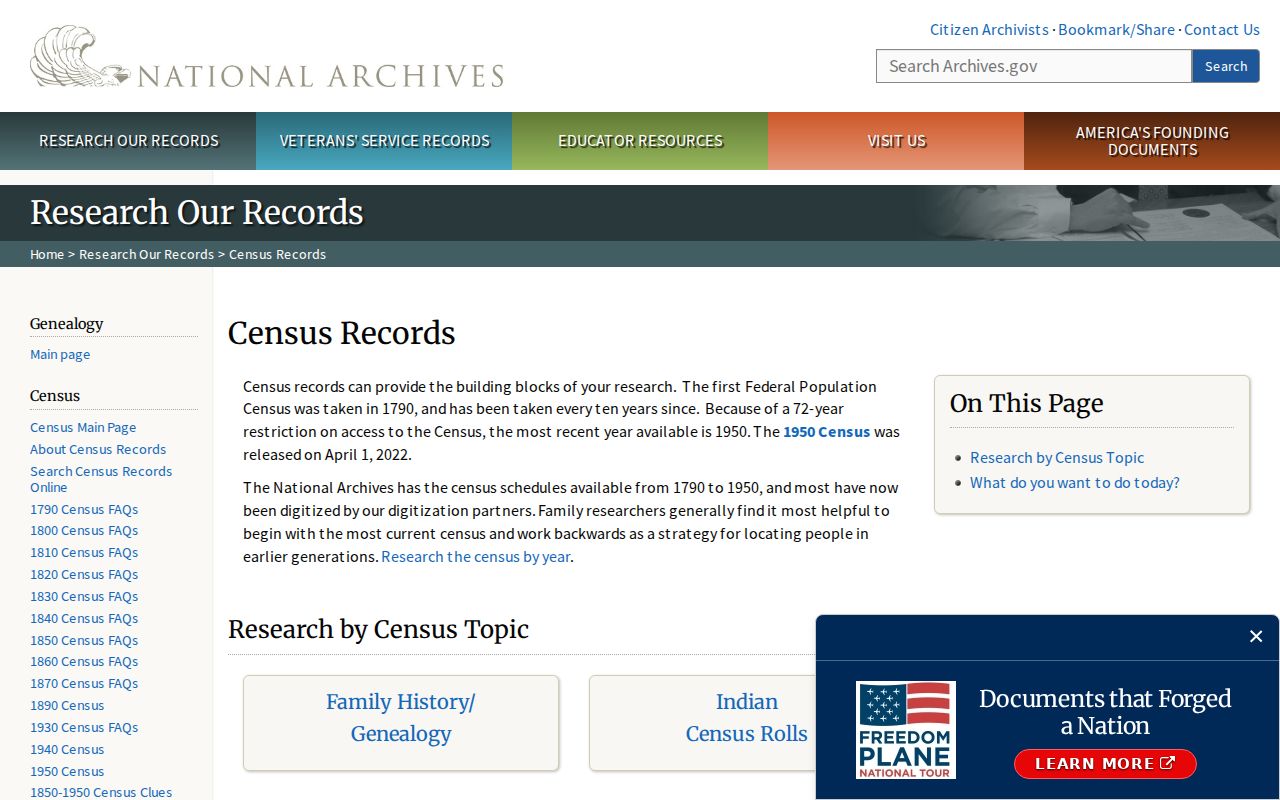
The census research image belongs to the national archival layer that complements an Upland city directory. Census schedules can add relationship, age, birthplace, occupation, tenure, and migration clues, while a directory can fill the intervening years and supply a more precise street reference.
Watch the geography. A pre-incorporation Upland resident may be enumerated under Ontario, North Ontario, or township geography rather than the modern city label. Compare household members and ages, not just a place string. When the directory and census disagree, preserve both observations and look for a newspaper, deed, probate notice, or later census that explains the difference.
Trace an Upland Household Through Years
A useful city-directory trail is built one dated observation at a time. Start with the clearest name and address combination, and keep the source page or call number beside each note. The following sequence helps separate a move from a missed listing.
- Find the person's first plausible appearance and transcribe the name, spouse or household clue, address, occupation if printed, and every abbreviation.
- Move forward through available directory years, recording whether the same name stays at the address, changes streets, appears under a spouse, or disappears.
- Flip to the criss-cross or street section when available. Compare the surrounding names, businesses, and street spelling rather than relying on a surname alone.
- Pair each useful directory year with the nearest 1900-1950 census schedule. Compare household composition, age, birthplace, and tenure clues.
- Close a gap with the digitized newspaper, obituary or probate notice, photograph, yearbook, or a property transaction. Use the county recorder index for transaction names from 1925-present, remembering that it is not an occupant list.
Disappearing from a directory does not prove that a person moved or died. The person may have been omitted, listed under a spouse, missed by the canvass, outside the volume's geographic boundary, or hidden by an OCR error. A later obituary or probate record can explain a disappearance, while a new address in a reverse section can show a move. When evidence remains thin, record the gap instead of manufacturing continuity.
Use the 1907 Upland Sanborn Layer
The 1907 Ontario Sanborn set is a useful quirky comparison for directory work because Upland appears as a secondary place within a 17-sheet map set. The Library of Congress digitized Sanborn resource supplies map images that can be compared with a directory street reference, but it is not a resident list.
Use the map to date a building footprint, identify a historical use, test an old street number, or understand how a block was organized. Then compare that observation with a directory entry, census household, newspaper notice, permit, or legal description. The Sanborn layer can show why two descriptions seem different as a place changes, but it cannot prove who owned a parcel or who lived in it.
Map boundary. A map records physical and use context. A city directory records listed people and businesses. A deed or recorder index records a transaction. Keep those three kinds of evidence separate when writing a Upland family or house history.
This comparison is especially helpful when North Ontario or Magnolia appears in an older source. It gives the researcher another dated layer for checking streets without pretending that an exact directory run, publisher, or citywide renumbering year has been established.