
Upland Resident Lookup Records
The right source depends on what must be confirmed. A county parcel record can connect a person to an assessed owner and a tax-mail route, while a court index can connect a name to a case. A voter tool authenticates the voter who is using it rather than opening a stranger search. Vital, business, professional, probate, and historical records each add a different kind of clue. Start with the narrowest official record that answers the question, then cross-check before describing a match.
| Record | What It Confirms | Where | Access |
|---|---|---|---|
| Assessor parcel | Assessed owner, parcel, and tax-mail route | San Bernardino County Assessor Property Information | Free public parcel and map search; not an occupant list |
| Recorder index | A person's role in a recorded transaction | San Bernardino County ARC Official Records | Free 1925-present index; image ordered or viewed at an office |
| Voter status | Authenticated status, address, party, and election details | California My Voter Status | Self-authentication; broader files require a permitted purpose |
| Court case | Party name, case type, status, events, and court geography | San Bernardino Superior Court CAP | Basic case information; documents and some name searches have limits |
| Vital record | Birth, death, public-marriage, or dissolution facts | County Recorder-Clerk or CDPH Vital Records | Authorized and informational copies follow different rules |
| Business or license file | Entity affiliation, license status, agent, or public discipline | SOS bizfile and DCA License Search | Free search; a filing is not proof of residence |
If the only known fact is a full name, begin with name variants and a likely geography, then test a court, business, or historical source. If the known fact is an address, capture the parcel and legal description before following names. For family history, combine the directory and newspaper trail with census or vital indexes. For an estate question, probate and obituary evidence can be more useful than a general name search. If an existing city or county record is not posted, the Upland City Clerk records-request route can seek a specific nonexempt record under the California Public Records Act, Government Code sections 7920.000 and following. A request cannot require staff to create a new list or answer legal research questions. The goal is not to collect every possible result; it is to link one person to two independent, dated clues.
Separate Same-Name Upland Matches
A same-name result is a lead, not an identity. Upland records can repeat a surname across unrelated households, businesses, and court cases. Preserve middle names, initials, suffixes, former names, and married names as separate search forms. Then compare stable identifiers and geography before combining records.
- Name form
- Run the exact spelling, initials, middle name, suffix, and known former or married name.
- Stable identifier
- Compare an APN, recorder document number, case number, license number, or entity number when the source supplies one.
- Geographic link
- Require an address, courthouse district, business locality, or historical place name that fits the person being researched.
- Date link
- Check filing, event, address, and household dates. A matching surname without a matching time period is not enough.
- Second source
- Use two independent geographic and date links before describing a match, and open the primary document when legally available.
Stop condition. If two people share a name and the records do not supply a stable identifier, keep both possibilities open. An aggregator cannot correct the county, court, or state record that created the confusion.
This discipline is particularly important when an old Upland name appears as North Ontario or Magnolia, or when a business filing lists a mailing address that is not a residence. A reliable Upland resident lookup says what the source proves and what it does not.
Search Upland Cases in CAP
The San Bernardino Superior Court Access Portal, or CAP, became the primary public case-information portal in October 2022. Its search modes depend on case type, but the documented fields include Case Number, Party or Name Search, Case Type, Filing Date Range, and calendar controls. Basic case information is available without charge in basic modes; some name-search functions or document sales may require current credits or fees. CAP data are limited for cases filed before 1998, and the court notes a daily update outage around 3:30-4:30 a.m.
| CAP field or mode | Type | Required | Upland lookup note |
|---|---|---|---|
| Case Number | Text | One search mode | Best exact route; preserve the court's hyphens and format. |
| Party or Name Search | Text | One search mode | Try surname or company with given name; common-name hits need cross-checking. |
| Case Type | Filter | Optional | Civil, criminal, family, probate, small claims, traffic, or other offered divisions. |
| Filing Date Range | Date pair | Optional | Narrows a common name; older online data are incomplete before 1998. |
| Calendar | Date, courtroom, or judge controls | Search-dependent | Shows hearing scheduling, not the full docket. |
The court's case-information notice explains the older-data limitation and the difference between electronic case information and a complete file.
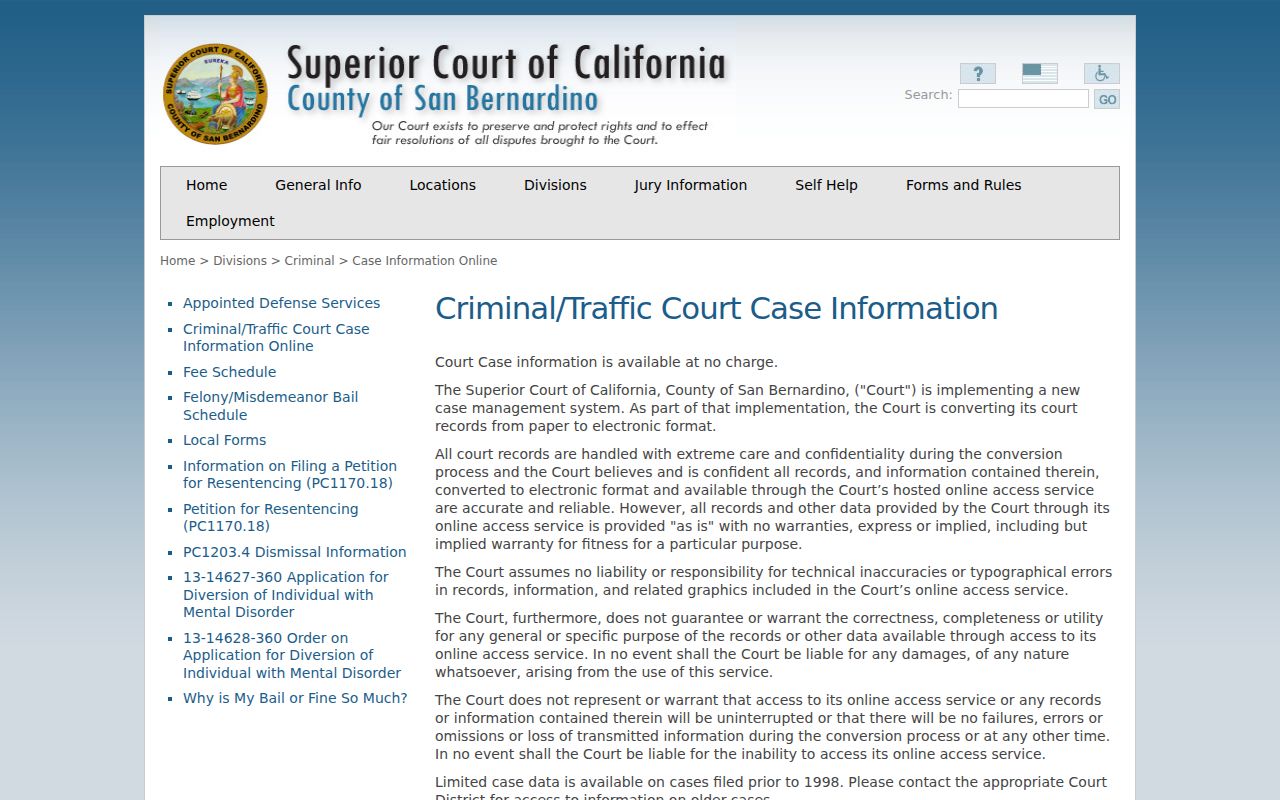
The court notice image is a reminder to treat CAP as a case index and status route, not as a guarantee that every historical document is online. Search the exact surname and given name, narrow by case type or filing range when available, and compare the listed district with the person's other evidence.
A typical accessible result may show case number, case title, filing date, case type, status, parties and roles, judicial officer, courthouse or district, hearing dates, register-of-actions entries, and a disposition. Full birth dates, Social Security numbers, victim identifiers, confidential addresses, juvenile material, adoption records, sealed records, and protected family information are not general web fields. Electronic data are supplied as-is during court conversion, so a result must be read with its access boundary attached.
Request Upland Court Files
When a CAP entry points to a case but the needed document is not online, contact the district where the case was filed. A resident lookup that needs the underlying file must follow the court's copy route. Civil, criminal, family, probate, traffic, and other files follow court rules, not the California Public Records Act. The court's administrative-record process is a different channel and should not be used as a substitute for a case-file request.
The San Bernardino Superior Court administrative-records request page explains the Rule 10.500 route for judicial administrative records.
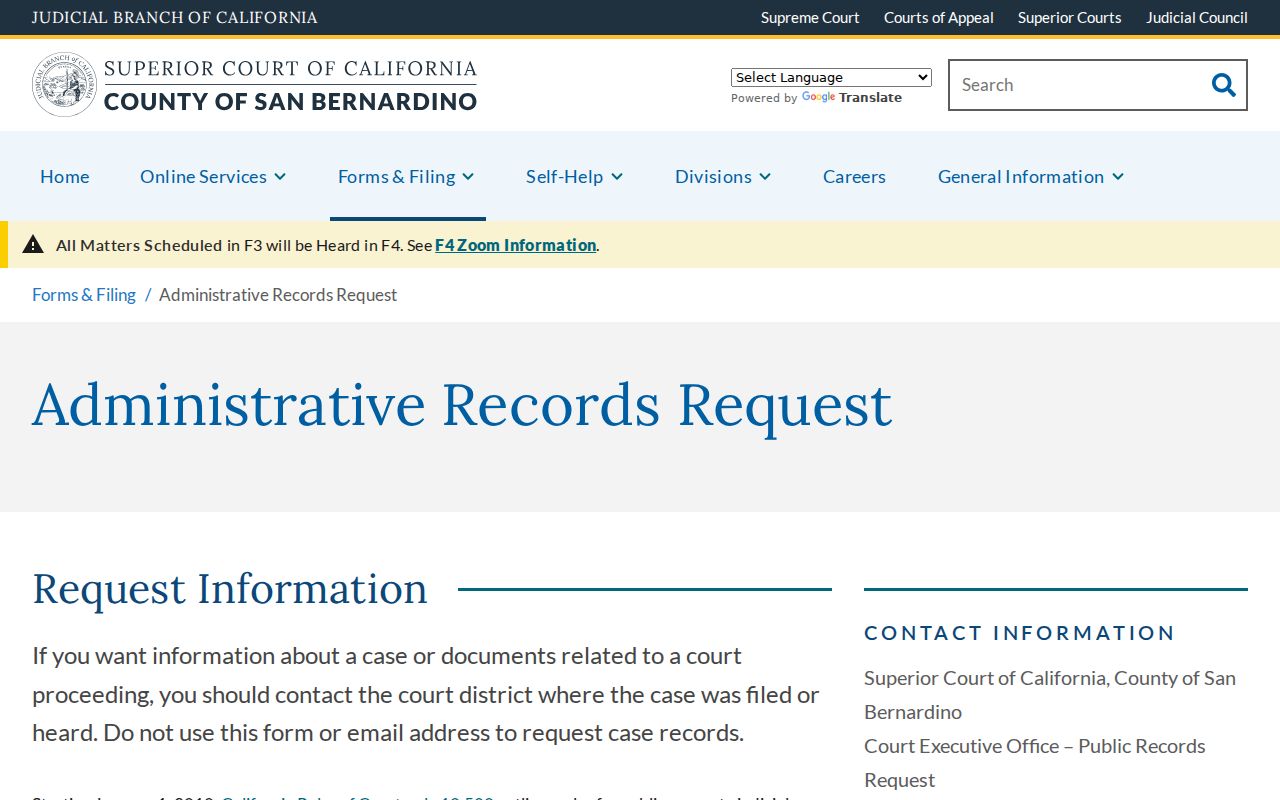
The administrative-request image marks the boundary between an agency-style records request and a file request from the clerk. For a case document, preserve the case number, filing district, document name, and requested copy type, then verify current retrieval and certified-copy charges with the court.
Federal matters take a separate path. The U.S. District Court for the Central District of California is the local federal court source for its own procedures and clerk information.
The federal court image belongs to a different jurisdiction from San Bernardino Superior Court. Search federal civil or criminal matters through the federal system, and do not merge a federal docket with a county case merely because the party name is the same.
PACER provides federal case and document access by party or case number. Its fees follow the current federal schedule, while courthouse public terminals may allow free inspection and charge for printing. Sealed cases and documents remain unavailable.
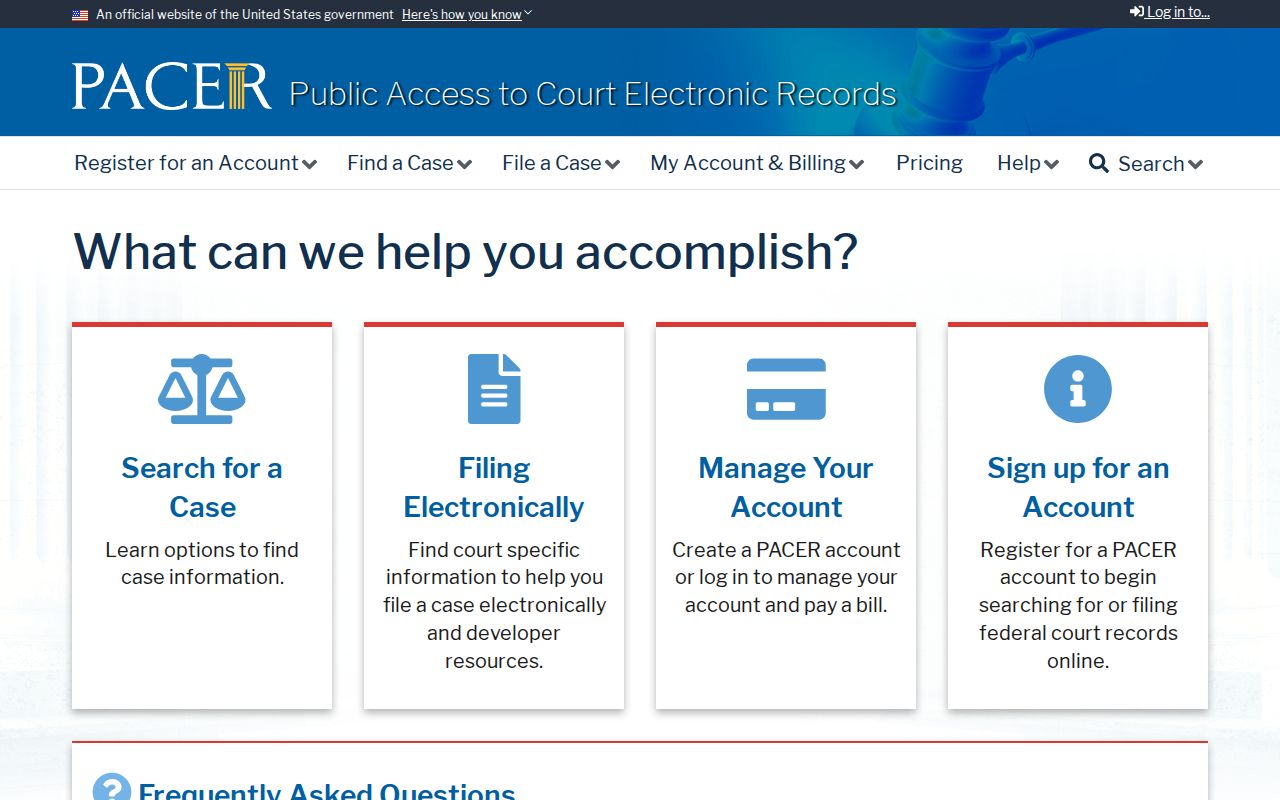
The PACER image completes the federal fallback path. Keep the court, case number, filing date, and party role in the result inventory so a later researcher can distinguish a federal record from a county CAP result.
- Docket
- A chronological record of filings, hearings, orders, and other case events shown at the level the court makes available.
- Index versus image
- An index or case summary is searchable text and status information. An image is the underlying document, which may require a clerk request, payment, eligibility, or an in-person inspection.
- Certified copy
- A copy that the custodian attests to as an official copy. It is different from printing an online result or saving an uncertified document image.
Compare Upland Mailing and Residence
The San Bernardino County Assessor Property Information and Parcel Access pages are useful when a name can be connected to an assessed parcel. The assessor separately provides historical assessment valuations from 1978-present, while the recorder name index covers recorded transactions from 1925-present. Neither system is a complete list of people who live at a house.
Keep two fields separate: situs is the physical parcel location, while the mailing address is where tax correspondence is sent. A tax mailing address can be a helpful public forwarding clue for an owner, but it is not guaranteed to be that person's residence. Renters and other household members are not supplied by the assessor roll.
- Start at Assessor Property Information with the known name or parcel lead and capture the APN, situs, map reference, and displayed mailing field.
- Use the APN and legal description to make sure the parcel, not merely the surname, is the same property being researched.
- Search the current assessed owner in the ARC recorder index, remembering that the index has no online document images.
- Order the deed or view it at the Hall of Records in San Bernardino or the High Desert Government Center in Hesperia when the transaction document is necessary.
- Compare dates and names with an independent court, business, vital, directory, or probate source. Stop short of calling the mailing field a current residence.
Check Upland Voter Status
California My Voter Status is a private self-lookup, not a public people finder. It authenticates the voter using the exact registration name, full date of birth, and either a California driver license or ID number or the last four numbers of a Social Security number. The form says the record must contain one of those exact-match identifiers and recommends using both when available.
- Required name
- First name and last name as registered.
- Date of birth
- Month and day selectors with year input.
- Identifier
- California driver license or ID number, or last four Social Security numbers, with an option for not having one.
- Returned status
- Registration status and address, party preference, language preference, polling place or upcoming-election information, vote-by-mail or provisional status, and county contact.
Use the My Voter Status authentication page only for the person entitled to authenticate. Wait at least 24 hours after an online registration before expecting the status to update; voters without the required identifiers are directed to the county or to elections@sos.ca.gov and 800-345-8683.
Legal boundary. A broader California voter file can contain name, date of birth, registration date, residential and mailing address, precinct, contact information, party preference, participation history, and political districts, but access is limited to authorized election, scholarly, journalistic, political, governmental, and other qualified purposes under Elections Code sections 2180-2194.1. The public self-lookup cannot browse a street or a stranger's name.
Use Upland Business Lookups
Business and professional records can confirm an affiliation without proving that a person lives at the listed address. They are useful when a resident is known through a company, a public practice, a trade, or a local business name. Search the source that owns the filing, and keep the entity, license, fictitious business name, and city license as separate records.
SOS bizfile. Search an entity name or file number. Advanced filters cover entity type or group, status, and initial filing date. Results can show entity number, formation date, jurisdiction, street and mailing addresses, agent, statement due date, officers, directors, members, managers, filing history, and free PDF images. Ordinary results cap at 500.
DCA license search. Search name, license number, license type or board, city or county, and status. Depending on the board, results show issue and expiration dates, public address, and discipline links. County FBN material comes through the San Bernardino County Recorder-Clerk, while local operating-license records are requested through Upland Finance or the City Clerk.
California Secretary of State bizfile search is free, though an account is needed to file or order some certified products. More than 17 million filing images are available, and entities created in late 2025 may have 12-character IDs beginning with B. The California Department of Consumer Affairs license search adds a board-specific status trail. A filing or license remains an affiliation clue, not a residence confirmation.
Trace Upland Heirs and Adoptions
Estate and family-history questions need a narrower workflow than a general resident search. For an heir, begin with a probate case in CAP or the filing district's file, then note the decedent, petition or notice, personal representative, and any public heir or relationship clues. Add an obituary and a second dated source before treating a relationship as established.
- Search the decedent's full name and variants in the county court system, then identify the correct district and case type.
- Read the public case inventory for the representative, notices, dates, and document references. Confidential exhibits and redacted details remain closed.
- Search the Upland newspaper and local-history trail for obituary, marriage, property-transfer, and family notices. The Upland city directory collection trail can add an address or household context.
- Compare names, dates, and geography across at least two independent sources. Do not turn an obituary's family wording into a current-address claim.
California adoption records follow a different rule. Original adoption and birth records are sealed under separate law, and California does not provide an open name lookup for them. Eligible adoptees and relatives should use the California Department of Social Services adoption-information and Mutual Consent channels, not an attempt to evade a sealed record. The official process determines eligibility and what information can be shared.
Family-history boundary. A probate clue can point to an heir, and an official adoption process can connect eligible relatives, but neither route makes sealed or confidential records public.
Order Upland Vital Records
California does not use a universal age cutoff that automatically opens every birth or death certificate. San Bernardino County Recorder-Clerk and CDPH distinguish authorized certified copies from informational copies under Health and Safety Code sections 103525-103526.5. A public informational copy can support research, while an authorized certified copy requires the applicant to fit a statutory category.
| Record | Custodian and 2026 fee | Access boundary |
|---|---|---|
| Birth | County ARC $34; CDPH VS 111 $31 | Authorized copy eligibility applies; an informational copy is not identity-valid |
| Death | County or CDPH $26 | County Public Health can be faster for very recent deaths before ARC receives them, roughly 30-60 days later |
| Public marriage | County or CDPH VS 113A $19 | Informational copies may be available; authorized-copy rules still apply |
| Confidential marriage | $19 where available | Generally limited to the parties or a court order |
| Dissolution certificate | CDPH VS 113B $18 | The Superior Court holds the decree or file; the state certificate is a separate product |
The county application asks for the requester, mailing address, contact information, record type, number of copies, names, event date and place, parents' names where applicable, relationship or authorized category, purpose, copy type, signature, and a notary acknowledgment when required. Mail payment uses check or money order; card charges add 3.5 percent. From July 1, 2026, county mail charges are $3.50 standard or $29 priority. A no-record result generally leaves the fee as a search fee, and third-party online processing can add two to three weeks.
Use the San Bernardino County vital-records application page, the CDPH vital-records hub, and the 2026 CDPH fee page for current forms. The state application identifies an informational copy as “INFORMATIONAL, NOT A VALID DOCUMENT TO ESTABLISH IDENTITY.”
Protect Upland Lookup Privacy
California privacy law changes what a commercial compilation may retain, but it does not automatically erase lawful county, court, or recorder records. The California Consumer Privacy Act and California Privacy Rights Act, Civil Code sections 1798.100 and following, give covered consumers rights to know, delete, correct, and opt out of sale or sharing, subject to exemptions. The California Privacy Protection Agency's DROP mechanism addresses covered data brokers; use current official guidance for eligibility and launch details.
Safe at Home supplies a substitute mailing address and mail forwarding for eligible survivors of domestic violence, stalking, sexual assault, human trafficking, elder or dependent-adult abuse, and certain reproductive-health workers or patients. Confidential voter-registration addresses have separate protections. These programs help keep a residential address out of specified public records, but they are not a retroactive deletion of every old record.
- Use the privacy or opt-out channel of a data company only when necessary, and provide the minimum identity information needed to verify the request.
- Save the suppression or deletion confirmation and recheck later because copied data can reappear.
- For a county, court, or state error, contact the actual custodian and follow its correction process. A directory service cannot change the source record.
- Do not seek DMV or utility subscriber addresses as if they were open resident rolls. The Driver's Privacy Protection Act and state law restrict motor-vehicle personal data.
Lawful personal use. Use an Upland resident lookup for a specific lawful purpose such as family history, estate work, reconnecting, or civic research. Do not use a result to stalk, harass, threaten, intimidate, or expose a protected address. California stalking and harassment laws can apply, and unauthorized voter-file use carries statutory penalties.