
How Upland Residents Start a Search
A useful resident search begins with the record question. The Upland residents directory is strongest when an owner question points to the county assessor and recorder, a current personal-status question points to California My Voter Status, and an old household question points to the Upland Public Library, newspapers, census pages, or a directory volume. No public source lists every person at an address, and a deed or tax mailing address is not proof of who sleeps there.
Keep a small log of the name form, address, date range, parcel number, and source used. That habit prevents a same-name record from becoming a false match. The five-part starter path below moves from the strongest current clue to older and less complete material.
- Start with the county Assessor Parcel Access map by a situs address or APN, and record the parcel identity, assessed owner field, and mailing field when displayed.
- Use California My Voter Status only for the authenticated voter, or study the county voter-file request rules before seeking an authorized geographic file.
- Move from a known owner or party name to the San Bernardino County Recorder’s 1925-present index, then order or view the underlying document when the transaction matters.
- For a past household, ask Upland Library staff about local directories, North Ontario or Magnolia references, newspapers, yearbooks, photographs, and oral histories.
- When an existing record is not online, send a focused request to the correct custodian under the CPRA or use the office, courthouse, or library channel described for that record set.
This sequence also works for one-person research. Confirm a name with two independent geographic or date clues before treating it as the same individual. A current public lead can be useful without becoming a claim about a resident’s private life.
Upland Records Desks and Custodians
Upland-created records start with the City Clerk, while county records hold the parcel, deed, election, and vital-record trails. A useful Upland residents directory names the custodian behind each trail. The San Bernardino County Assessor-Recorder-Clerk, Registrar of Voters, and Upland Public Library each answer a different part of a resident question. The desk matters because a request sent to the wrong custodian can return no record even when the record exists elsewhere.
Upland City Clerk
460 N. Euclid Ave.
Upland, CA 91786
909-931-4120
Mon-Thu, 8 a.m.-6 p.m.
San Bernardino County ARC
Hall of Records
222 W. Hospitality Lane, San Bernardino
Recorder 909-387-8306
Assessor / Parcel Access
San Bernardino County Assessor Services
Parcel and assessment information
909-387-8307
Registrar of Voters
777 E. Rialto Ave.
San Bernardino, CA 92415-0770
909-387-8300
Upland Public Library
Local History Collection
450 N. Euclid Ave., Upland
909-931-4322
Non-circulating local research
The City Clerk request page distinguishes an existing record from a question that would require staff research. City records can include permits, local licenses, code files, council material, public notices, and police-report procedures. Police reports have an involved-party and identification limit, and Upland Police lists a $30 report fee. Birth, marriage, and death certificates are county ARC matters, not separate city certificates.
The Upland City Clerk request page is the source for the request route pictured below.
The City Clerk image points to a request route for records that never appear in a resident directory or county index.
Upland Parcel Search Fields
The county property roll is often the first practical lead because an address can be converted into an APN, or assessor parcel number. Use the situs address, not a tax mailing address, as the first key. The public Parcel Access material supports address and property-ID paths, map clicks, and parcel layers, with historical assessment valuations from 1978-present. It does not promise an unrestricted owner-name bulk query or a complete household list.
| Search field or mode | Type | Required | Upland use |
|---|---|---|---|
| Property address | Text or autocomplete | One key | Enter the situs address; normalize direction and street suffix if needed. |
| Assessor Parcel Number / Property ID | Text | One key | Use the APN to connect the map, assessment card, and later deed work. |
| Map navigation | Pan, zoom, and click | No | Select a parcel polygon and then inspect nearby parcels one at a time. |
| Layers and basemap | Map controls | No | Parcel data is joined with broader city context through Community View. |
Typical parcel fields may include the APN, situs, assessed owner when displayed, tax-bill mailing address, legal subdivision reference, values, assessment year, characteristics, exemptions where displayable, and geometry. Assessment data do not establish every occupant, permitted use, or legal title. Recorded documents and the city land-use office answer different questions.
The San Bernardino County Assessor Property Information page supplies the parcel-search entry point shown here.
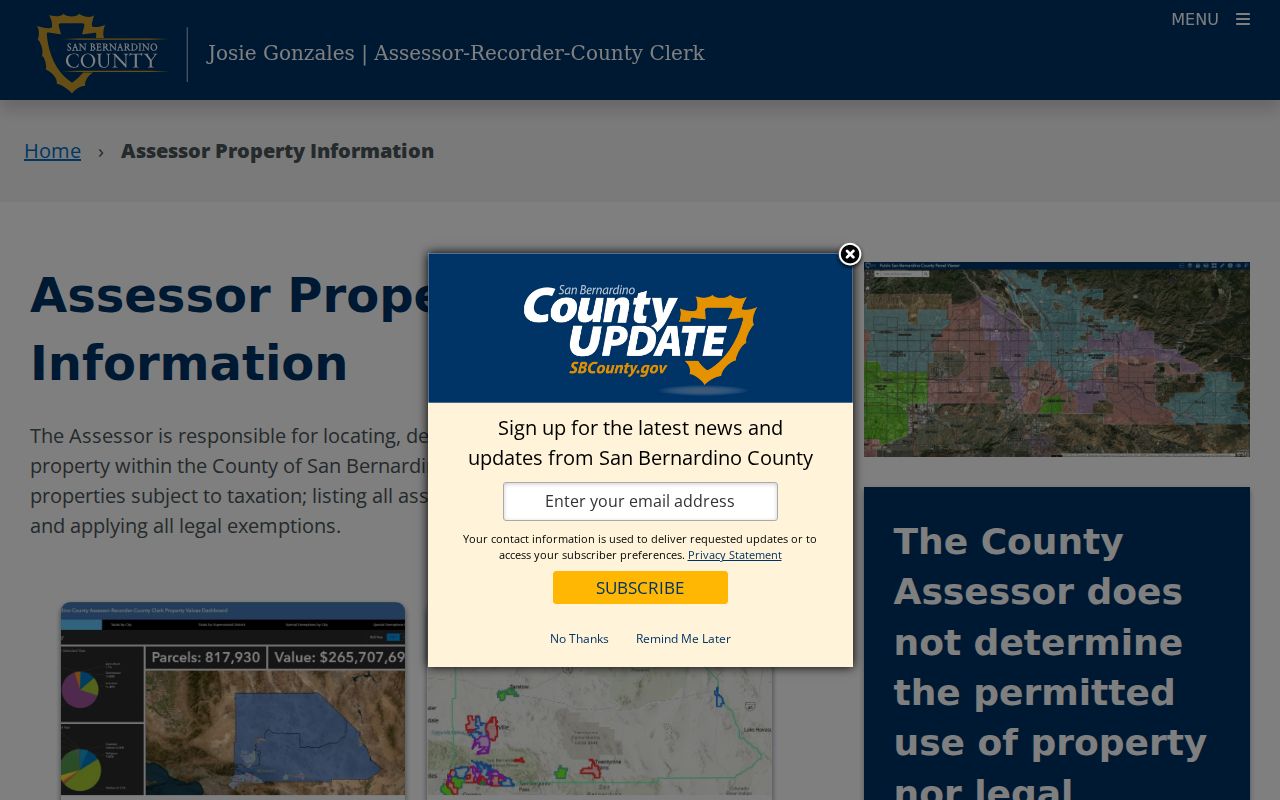
That assessor view is best treated as a parcel key. It gives the next search step, not a conclusion about a household.
The Upland Recorder’s 1925 Boundary
San Bernardino County’s online Recorder Index begins in 1925 and is index-only. Entries are organized around document number, document date, document title, grantor, and grantee. The index does not search ownership by street address and does not expose document contents on the web. Begin with the APN and current assessed owner, then search the owner as a grantee before following the seller backward.
A deed identifies an ownership transaction, not every occupant. To verify the link, order the acquisition document or inspect it at the Hall of Records or the High Desert Government Center in Hesperia. The county recommends appointments for onsite work. A noncertified ordered copy can be emailed, while a certified copy is shipped. Copy charges listed in the research are $4 for the first page and $1.50 for each later page, with other order or mail charges depending on the channel.
The ARC Official Public Records page is the source for the county index and its image-access boundary.
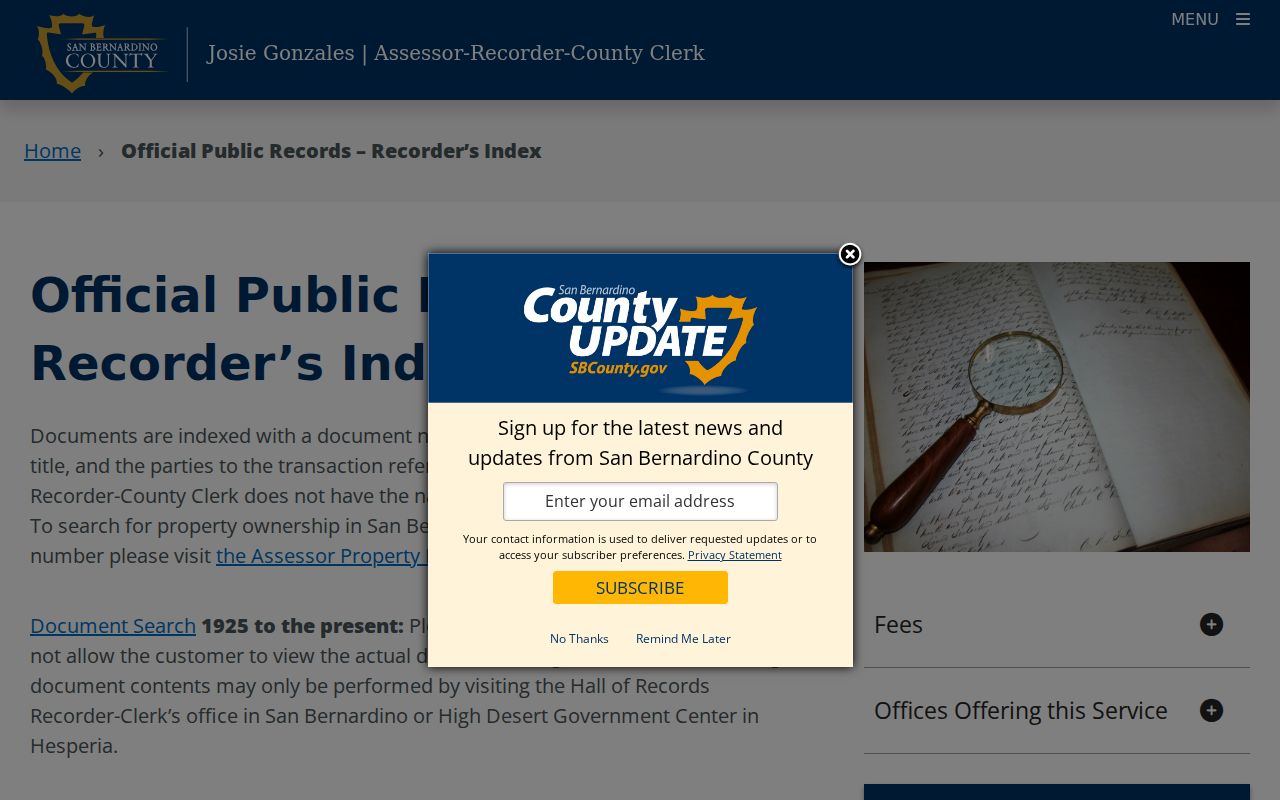
The recorder image makes the key distinction visible: a free party index is a lead, while the deed copy supplies the legal description and transaction detail.
- Roll
- A recurring government record set, such as an assessment or voter roll, with a defined keeper and purpose.
- Index
- A finding aid that points to a record; it may omit the full text, image, or protected fields.
- Parcel
- A mapped unit tied to an APN, situs, legal description, and assessment record.
- Criss-cross directory
- A reverse-style directory that may arrange listed names by street address instead of only by surname.
Today’s Upland Resident Record Sources
“Directory” means different things across Upland records. The Upland residents directory is a set of linked sources rather than a single roll. A parcel card can identify an assessed owner. A recorder entry can place a party in a deed or lien. A voter tool can authenticate one voter, but it is not a street browser. A city request can reveal an existing permit or local license, while library material can show a published household at an earlier time.
| Source | Keeper | Useful resident clue | Access boundary |
|---|---|---|---|
| Parcel and assessment information | San Bernardino County Assessor | APN, situs, assessed owner or mailing field where displayed | Free public map; historical valuations from 1978-present; not a household roster |
| Recorder’s party index | San Bernardino County ARC | Grantor, grantee, document type, date, and number | 1925-present online index; images ordered or viewed at an office |
| My Voter Status | California Secretary of State | Authenticated voter status, address, party, and election details | Exact personal authentication; not a stranger or street search |
| City permits and local records | Upland City Clerk and departments | Address, APN, owner, applicant, contractor, work, and dates where public | Online when indexed; focused request for gaps and exemptions |
| Local history and directories | Upland Public Library | Published occupants, names, businesses, photographs, and community ties | Non-circulating collection; volume and year coverage need staff confirmation |
The right source depends on the desired proof. A street-by-street parcel chain needs APNs and map clicks, while one person’s identity needs two independent clues. The address workflow has a fuller treatment in the Upland street directory material, where the assessor, GIS, deed, permit, and voter layers are kept in address order.
California Voter Status for Upland Residents
California My Voter Status is a self-lookup. It asks for first name, last name, full date of birth, and either a California driver license or ID number or the last four numbers of a Social Security number. The service reports the authenticated voter’s registration status and address, party preference, language preference, polling place, election information, vote-by-mail or provisional status, and county contact details.
It is not searchable by street or by a stranger’s name. The county voter file is a separate product. Requests must state a qualifying election, scholarly, journalistic, political, or governmental purpose under Elections Code §§2180-2194.1, describe the geography and intended use, identify who will have access, and include security and legal acknowledgments. Commercial use and harassment are prohibited.
California My Voter Status is the source for the authentication form represented here.
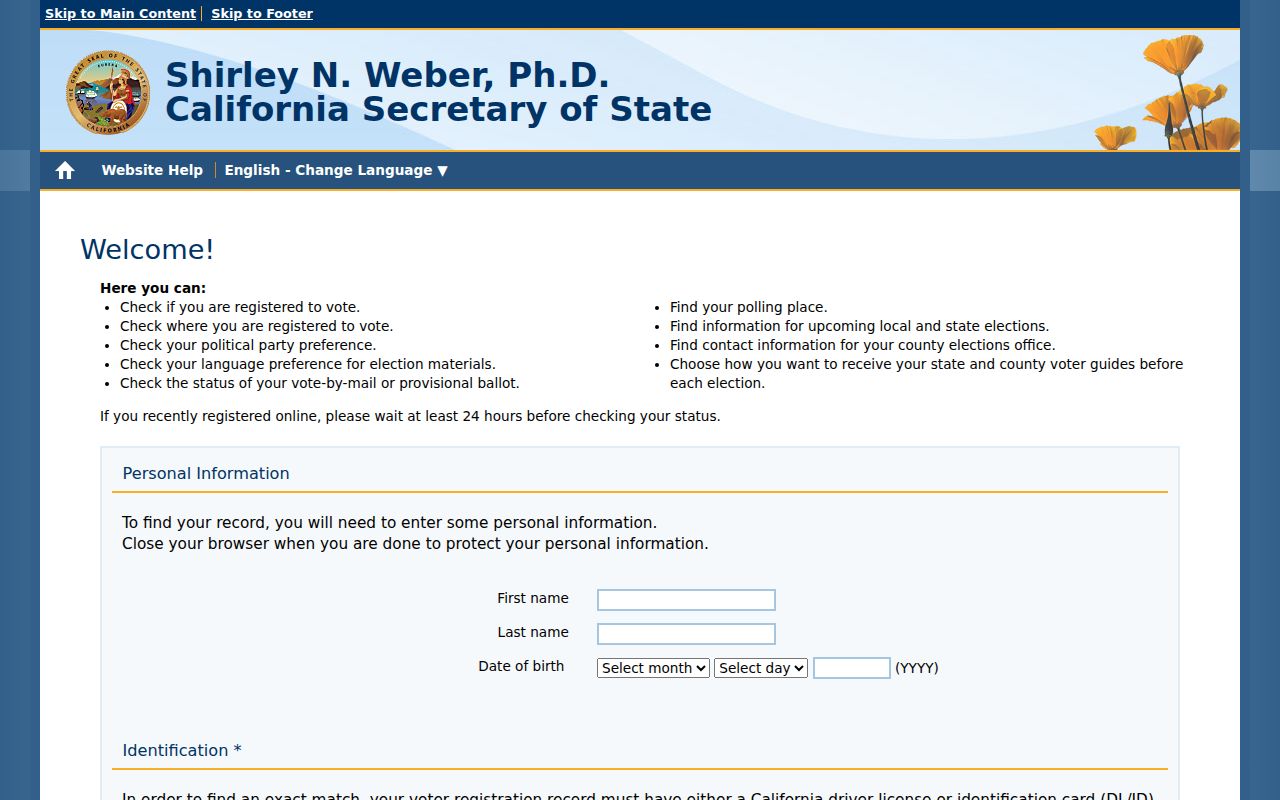
The form’s exact-match design protects the voter while still giving an individual a direct way to check their own record.
Upland Court Records Before and After 1998
San Bernardino Superior Court’s Court Access Portal, or CAP, is the case-information route for civil, criminal, family, probate, small claims, and traffic matters assigned to the county districts. Basic case information can show a case number, title, filing date, type, status, parties and roles, judicial officer, courthouse, hearings, register-of-actions entries, and disposition when that data is available.
The court warns that electronic case information is limited for cases filed before 1998. CAP information is not the same as a court file, and court files do not follow the CPRA request path. Contact the district where the matter was filed for viewing or copies. Federal matters belong in the Central District of California and PACER, not the county portal. A party hit is only one branch of the Upland residents directory and needs a case type, date, and geography check before it is tied to one resident.
The San Bernardino Superior Court Access Portal is the source for this case-search view.
The CAP image belongs in a verification trail, not in a claim that a court result proves a person’s current address.
Official Upland Rolls Compared
Official records and compiled search tools serve different roles. A custodian’s index is closer to the source and shows the limits set by that office. A commercial compilation may gather many public snippets into one result, but it can merge names, lag corrections, omit nonowner occupants, or charge for a record that the custodian makes available directly. Use a compilation, if at all, as a lead for personal research rather than as proof.
| Question | Official Upland or California source | Compiled search tool |
|---|---|---|
| Who is tied to a parcel? | Assessor card, APN, and recorded deed reviewed together | May mix an old owner, a mailing address, or a matched name |
| Is one person registered? | My Voter Status for that person, or an authorized voter-file process | Cannot replace authentication or Elections Code limits |
| What happened in court? | CAP summary and the filing district’s court file process | May copy an incomplete case label without the docket context |
| Where did a past household appear? | Library directories, Upland News, census, and primary records | May flatten dates and confuse an old address with a current one |
Two-source confirmation is the better standard. Pair a name with an APN, document number, case number, license number, business number, date, or known place. Do not turn a partial match into a public accusation or a statement about a living person.
Upland Vital Records by Copy Type
Birth, death, and public-marriage certificates for Upland events are handled chiefly by the San Bernardino County Recorder-Clerk, with California Department of Public Health as the statewide office. Very recent deaths may first be held by county Public Health before ARC receives them roughly 30-60 days later. California uses authorized certified copies and informational copies rather than one simple rule that makes every record public after a set number of years.
Under Health and Safety Code §§103525-103526.5, an authorized applicant must fit a statutory category. An informational copy can help genealogy but is marked as not valid to establish identity. Confidential marriage records are restricted to the parties or a court order. For 2026, the county lists birth at $34, death at $26, and marriage at $19; CDPH lists birth at $31, death at $26, marriage at $19, and dissolution certificates at $18. Fees act as search fees when no record is found, and authorized county mail requests require a notarized sworn statement.
San Bernardino County vital-record instructions are the source for the county application route shown here.
The application view reinforces the distinction between finding a historical clue and ordering a certificate with legal access rules.
Upland Business Records as Identity Clues
A person connected to an Upland business may leave a clearer public trail through California Secretary of State bizfile, a county fictitious-business-name filing, or a city license. Bizfile searches by entity name or number, then offers advanced filters for entity type, status, and initial filing date. The standard search can return up to 500 results, while more than 17 million filing images are available free. An entity address is an office, agent, mailing, or principal address, not automatic proof of a home.
Late-2025 California numbering changes mean new corporations, LLCs, and LPs can have 12-character IDs beginning with “B”; older entity numbers remain. A professional-license search adds a different identity clue through name, license number, board, city or county, and status. These filings help resolve a name or business relationship, but they are time-stamped and should be checked against the actual document.
California bizfile Online Business Search is the source for the business-record search screen.
The business search is most useful when a name also appears in a Upland newspaper, permit, local license, or directory entry.
The Upland Library Historical Shelf
Upland Public Library’s Local History Collection reaches the late 1800s and is non-circulating. Reference and Local History staff can help identify directories, city and business documents, newspapers, photographs, school yearbooks, oral histories, and local history files. The collection is especially valuable before modern online indexes, when a published address or community note may be the only surviving resident clue.
The library is at 450 N. Euclid Ave. and lists hours of Monday through Thursday 10 a.m.-7 p.m. and Friday through Saturday 10 a.m.-6 p.m., with Sunday closed. California Revealed is digitizing Upland News, founded in 1901 as the North Ontario News. The library also points researchers to Calisphere, the Online Archive of California, Ancestry Library Edition, and FamilySearch. Exact directory publishers, volumes, reverse sections, and year runs are not published online, so ask staff rather than assuming a familiar commercial title is present.
The historical collection has named material connected with Esther Boulton Black, Edna Swan, Hispanic oral histories, Sam Maloof, and local photographs. An Upland residents directory that reaches back through those materials needs the volume-by-volume method on the Upland city directory collections page when an old address needs a published household entry.
Upland Library local history information is the source for this collection orientation.
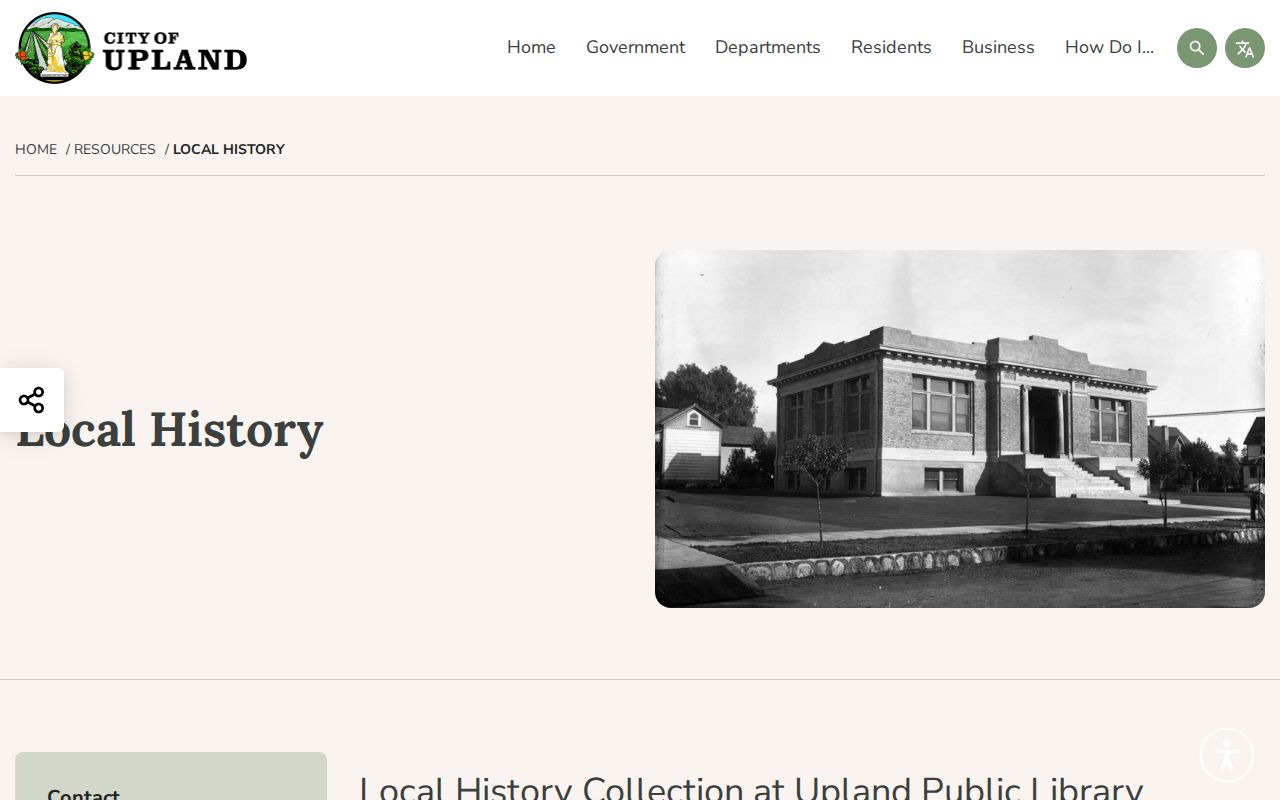
The library image fits the older side of an Upland residents directory, where staff guidance joins names, places, and collections that do not share one search box.
North Ontario, Magnolia, and Upland Names
Late-nineteenth-century Upland residents may not be filed under Upland at all. The area was known as North Ontario or Magnolia before the city incorporated in 1906. Upland News began in 1901 as the North Ontario News, so its early issues preserve the older place name. Search all three terms in a directory, census page, newspaper, map index, or library catalog.
This name shift is a practical search quirk, not a minor history note. A record that seems absent under Upland may appear under Ontario, North Ontario, township geography, or Magnolia. Match the person, street, business, and date before treating a change in place label as a move.
Upland Community View for Local Context
Upland Community View and the county parcel map add geography to a name search. The city’s verified layers include parcels and property data, zoning, historic districts, voting districts, Metrolink, airport safety overlay, pressure zones, parks, public schools, school districts, and public facilities. Click a target parcel, note its APN, and use the same identifier in the assessor or recorder trail.
Map context can explain why two records point to different custodians. A postal Upland label does not always mean the parcel sits inside the incorporated city. In particular, 91784 reaches the San Antonio Heights area, which is unincorporated and can route land-use or fire records to the county. A map layer supplies context, not legal title or a resident list.
Upland Community View and online maps is the source for the local context shown here.
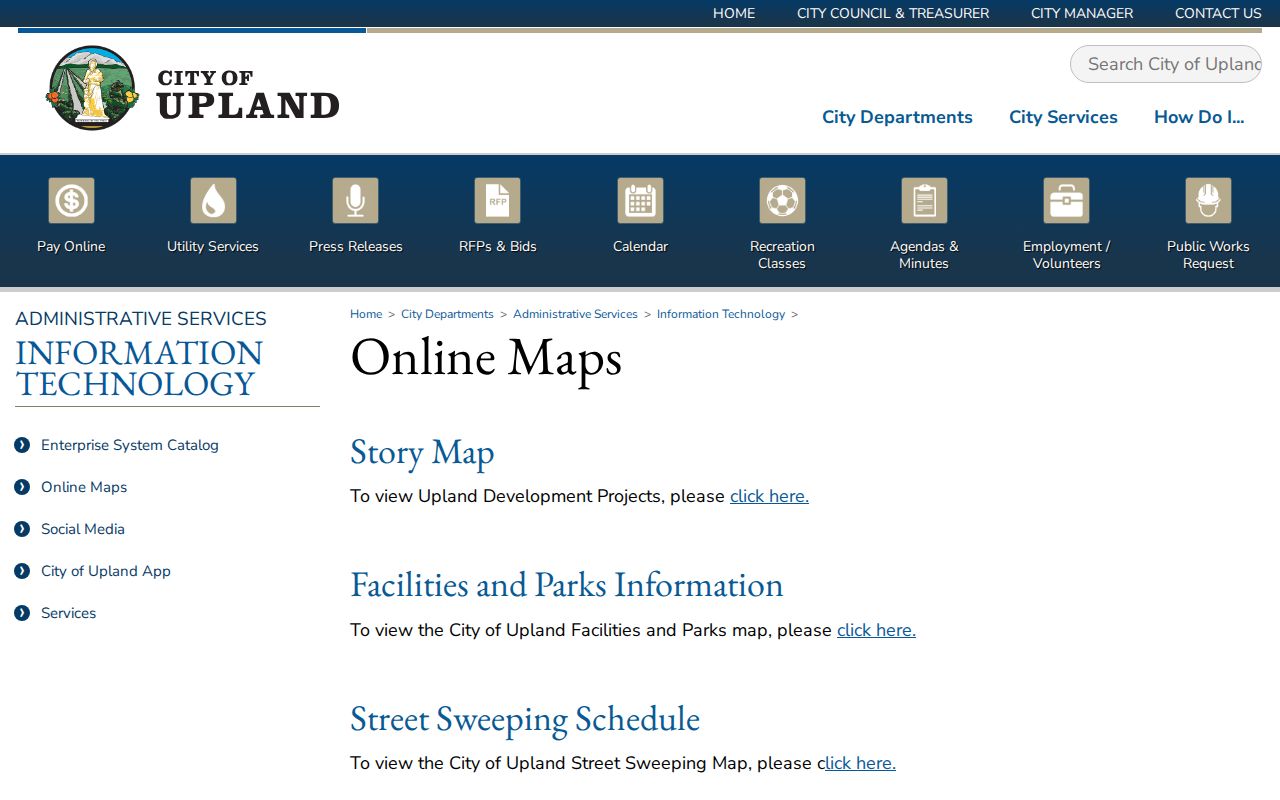
The Community View image shows why an address, parcel, postal city, and municipal boundary must be recorded as separate facts.
Narrow Custody Records for Upland Searches
The San Bernardino County Sheriff Inmate Locator is a focused custody tool, not a complete criminal-history or resident directory. A name may be entered with or without a middle name because booking practices vary. A result can give a facility or booking number and related custody information, while photos are generally not released. The closest county facility to Upland is West Valley Detention Center in Rancho Cucamonga, but custody status can change through release or transfer.
California’s CDCR locator and Megan’s Law provide separate statewide routes with their own search limits and warnings. An absence from any locator does not establish that a person has no record. Verify the jurisdiction, spelling, date, and source before drawing a conclusion, and use safety information only for lawful personal purposes.
The San Bernardino County Sheriff Inmate Locator is the source for the custody search shown here.
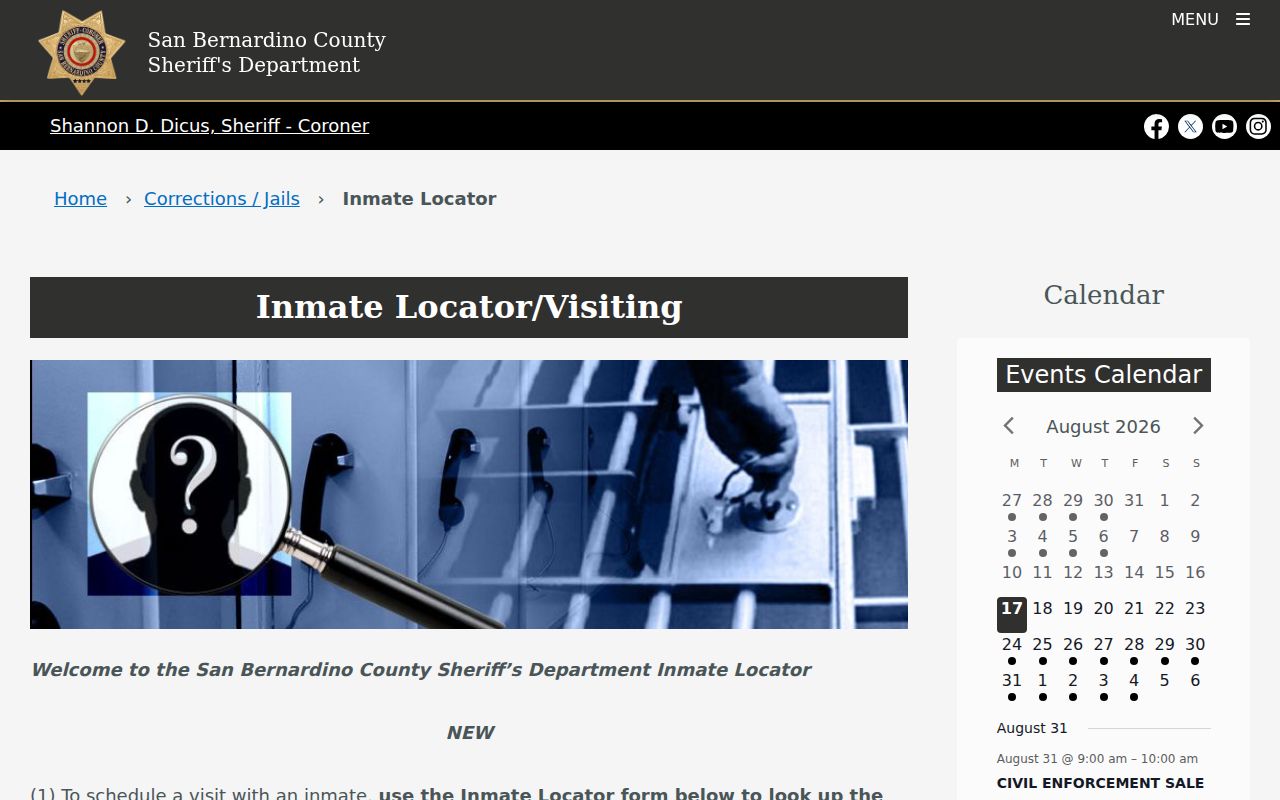
This locator is one narrow branch of an Upland resident search and should never be treated as a general list of local people.
Safe and Lawful Upland Resident Research
California’s CPRA, Government Code §§7920.000 et seq., supports inspection of nonexempt state and local records, but it does not require an agency to create a new record, answer a broad question, or disclose exempt personal information. A focused request names the custodian, address or APN, record type, and date range. Court files, voter files, motor-vehicle data, and confidential vital records follow separate rules.
Lawful personal use. Upland records can support family history, civic research, reconnecting, estate work, and personal safety. Do not use names, addresses, voter data, court data, or custody information to stalk, harass, threaten, intimidate, or harm another person. Verify a record with the office that holds it and stop when a protected address or private field closes the trail.
California’s Safe at Home program and confidential voter-registration rules protect qualifying people. The California Privacy Protection Agency’s guidance can help with commercial data-broker rights, but lawful recorder and court records are not erased simply because a person dislikes their existence. A careful Upland residents directory respects the record’s purpose, the person’s safety, and the difference between a clue and proof.